Friday, 5 April 2019

Lakes, Dales, and Moors - The Northern England Short Tour


Well, I was going to have a bit of a break from cycle touring after Spain, but I have never been to the far North of my own country, and with 3 supposedly stunning national parks in this region, I couldn't resist.

I plan to take the train to London from my hometown in Colchester, then head up to Carlisle, where I will disembark on the bike.  Carlisle is one of the most northerly cities in England, just 10 miles south of Scotland.  From there it is a relatively short ride into the Lake District National Park.

Famed as one of the most picturesque locations in the UK, it is also one of the wettest (these two factors almost always come together), so it is a big fingers-crossed for the weather on this trip, especially as April isn't exactly the driest time of year.

The weather isn't the only challenge, my route takes me through the Lake District, then the Yorkshire Dales, and finally the Yorkshire Moors, where I will rendez-vous with my aunt and uncle for a day or so before going back home to Colchester with my mum.  This route takes me up and down some serious climbs.

I don't know how I do it to myself, every time I go somewhere new, I seem to be setting myself another horrendous physical challenge.  This time it is not distance, it shouldn't be the wind - as I should be travelling with the prevailing wind for most of the ride, although it looks like the winds are shifting just for me (as usual) - and it certainly won't be heat and lack of water as in Australia.  This time it will be the sheer steepness of the climbs.

After doing a bit of research, I have noticed that I will certainly hit some sections of road where the incline will exceed 25%!  There are also roads where climbs can reach as high a gradient as 33%!  I will be cycling backwards!  In New Zealand, the steepest section of road I encountered was about 16% up to Arthur's Pass, and that was brutal.  I will be packed a lot lighter for this tour, but I can't imagine I will be able to cycle the whole way up such roads, not to mention ride down them - it is recommended that cyclists dismount going down some of these roads.

I have about 5-6 days to complete this ride, which works out at about 60Km a day, which should be manageable, but I would like a day in hand in case of bad weather, and with these hills, well, I might need that extra day.

The weather is really my major concern.  A few days away now, and if I can trust the long range weather forecast, it looks like it will be cold, but not wet, which is just fine by me.  If I have some good weather, the scenery should be absolutely beautiful.

With some flexibility built-in to the tour, if the weather is good, I may hike up to England's highest mountain, Scarfell Pike, which is not a big detour off my route through the Lake District.  It is always good to get off the bike and do some hiking as well.

Looking forward to this short, punchy, and potentially very picturesque tour of the North.  Hopefully the bike and the gear holds out, as much of it is on its last legs; the panniers are being held together with pegs with a few holes appearing, the bike is starting to develop the odd minor problem or two (understandably after all the hard work she's done), and my racks are bent and being held together with cable ties after a breakage or two in Australia and New Zealand.  She just has to get me through this one last tour, and I'll make her a commuter bike, but what a job she has done over the past 3 years.  Let's see how this one goes.

Sunday, 24 February 2019

The Spectacular Roads and Mazes of Spain


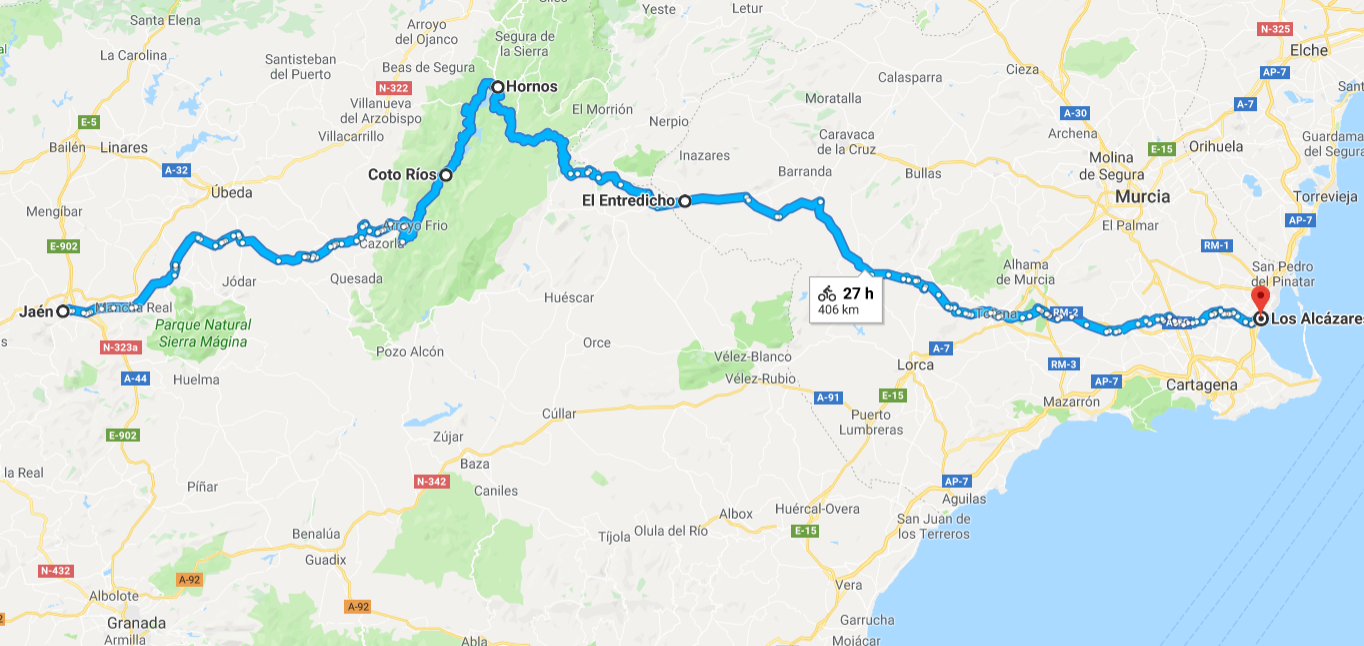
Another tour done and this one didn't exactly go to plan.  To be fair, only the first tour I did in Australia and my tour in England have gone exactly to plan, most of the tours I have done have had at least minor changes once I am in the reality of the situation.


My actual tour route. Slightly different than planned.
For this one, I significantly overestimated the mileage I could achieve in a day.  Perhaps I am getting old, but I think the main issue in this case was the difficulty of finding my way around.  Stopping to check maps, going the wrong way, and winding your way through mazes of roads takes a lot more time out of your day than you imagine.

One of the great benefits of having a very common name is that I often come across things like this.
Spain has to be one of the best places for cycling in the world; there are plenty of hills and mountains, stunning vistas, the weather is almost always sunny, and the roads are in great condition with very little traffic.

Great for cycling, definitely, but good for bicycle touring?  I'm not so sure about that.  If someone were to ask for my advice about cycling in Spain, I would advise them to fly over with their road bike and do day cycles, maybe hiring a car and finding a 100Km ride to do, then do something similar somewhere else on another day.


The reason for this is that there some wonderful roads, but getting from a to b on a bike over a period of days and weeks can be tricky in Spain.  The are a number of different kinds of roads here; APs, AVs, As, RMs, GLs, ALs, etc.  The first two seemed to always not allow cyclists on them, but the As and RMs also had times when they didn't allow cyclists, but the problem was that you didn't know until things started looking like a motorway or when a sign popped-up.  There didn't seem to be any hard and fast rules to it all.


Going down the side of these more major roads were service roads that looked very good at times, but would often deteriorate into rubble or just end altogether without warning.

My troubles with the roads were summed-up on the last day when I discovered that I could not legally enter Murcia International airport on the bike, despite two bicycle lanes appearing to lead right into the airport (at least on the map).


When I arrived I must have ridden on the road illegally to get going, not seeing any signs.  But on the way in, I saw the signs clearly so diverted down a service road with a bicycle path that led to the airport.  Having discovered that one bicycle path came to a dead end with a 2 metre-high fence, I tried to cycle around, only to discover that this fence stretched on seemingly endlessly.


Turning back, I tried the bicycle path on the other side, but the same thing, it ended at a very high fence.  The airport was in sight the whole time, but I just couldn't reach it.  Hopping onto the main road was not an option either as it was protected by yet another fence and a rather large gutter.  Fortunately, however, a tree had fallen on the fence and this acted like a bridge so I could cross the gutter (slightly precariously) with my bike and then lift it over the barrier.  Without that tree, I have no idea how I would have gotten into the airport.

Wild camping with the new tent.
I had another problem, and that was that I couldn't put my bike on the trains, which meant that my original plans to take the train to Seville and Cordoba was pretty much finished.  In the end, I just cycled to Granada via the coast and then circled back to my Dad's place in Los Alcazeres.

Even then, I had to take the bus between Guadix and Baza because I couldn't find a route that would accept my bicycle.


Troubles aside, when I was actually cycling, the roads and scenery were absolutely beautiful both on the coast and inland.  Despite the fact hills and mountains were everywhere, I found the gradients a lot less severe than New Zealand also, so no climbs were especially tough, particularly with less gear on the bike. The ease of wild camping was also very welcome.  Pretty much any area without houses or farms was easy to just turn off the road and find a nice sheltered place to camp.

It was a shame I couldn't go to Seville or Cordoba, but Granada was a truly beautiful city to spend a day resting and wandering around in.  A combination of Christian and Islamic architecture with the backdrop of the Sierra Nevada mountains.  European cities are so beautiful, sometimes you forget it when you travel elsewhere in the world.  Australia and New Zealand have the natural wonders, but culturally, hardly anywhere in the world beats Europe.


The main attraction in Granada was Alhambra, a large Islamic fort set on top of a hill overlooking the whole city.  It was an impressive sight, and as usual, I was there early in the day to get in before all the crowds of tourists showed-up.  So early in fact, that I managed to beat the entrance fee as well, and sneaked in for a walk around the castle on my own as the sun rose across the city.  This was a great pick-me-up after the disappointment of not being able to carry out my original plans.


Once I had finished with Alhambra I explored the old quarter of the city, winding through the hilly streets and taking pictures of some of the quaintly beautiful architecture.

The afternoon before, I checked into my only paid accommodation of the whole tour.  At 35 Euros it was quite a luxury for me, especially with my own room.  I had intended to stay at a much cheaper hostel, but typically showed-up in Granada at the weekend and everywhere was full.  This did surprise me, though, as I wouldn't have expected the city to be busy with tourists during winter.


It was a great relief to have a shower and have my own comfortable bed and just be able to catch-up with the world for the evening.  When you cycle all day for consecutive days, you really earn your rest.

The way out of Granada towards a town called Guadix was some of the best cycling of the trip, with steady gradients into the mountains.  For this reason it was also popular with a lot of other cyclists; I have never seen so many in a day.  They were not of the touring kind, but bicycles outnumbered cars significantly all day.  As they all rode by me I was given quizzical looks, like why was I punishing myself by riding with all this gear up a mountain.


I managed to get up to about 1300m, a few hundred metres higher than any road in New Zealand, and passed many pretty villages on the way to an extremely chilly overnight camp next to tunnels drilled in the rock.  These tunnels were slightly mysterious, but over the other side of the valley I had noticed some houses that were actually part of the rock and mountainside.  I assume that I was camping next to a work in progress, as I saw a few of these kinds of houses in this area of Spain.


Some pleasant roads then followed on the way back to my Dad's place in Los Alcazeres, but on one section from Guadix to Baza the route planning was nigh on impossible.  The only way on the bike looked as if I would be doing an extra 100Km or more because the direct route was on a road I couldn't cycle on.  For this reason, I decided to hop on a bus for 60Km, which actually wasn't nearly as troublesome as I anticipated.


I got back to Los Alcazeres a day early, which I was very happy about so I was able to get some rest before the stressful business of packing up and going home.  It had been an eventful trip, much harder logistically than I had imagined, but it had been nice to take a break from the doom and gloom of a British winter and get some sunshine, which it was every single day.


I am thinking now of taking a break from the cycle touring, at least the conventional kind.  The plan is to move to New Zealand in 2020 and I have no plans for any more bike tours in 2019.  I am certainly thinking of other things though, like a return to some hiking and maybe some running.  Once in New Zealand, I am hoping to hit the trails on a new bike and perhaps do some bikepacking.  The adventures will definitely continue.

Tuesday, 5 February 2019

Southern Spain 10-Day Andalusia Tour Plan


It is always a bit sad when you finish an epic tour.  After about 4 months in New Zealand and over 5 months touring in Australia before that (not to mention 2 weeks touring in California), 2018 was quite a year of bicycle touring, and not one that I can imagine repeating again any time soon (I have to grow-up some day).  I was in dreamland, and with hours and hours of beautiful southern hemisphere sun with some idyllic scenery as a permanent backdrop, I had been spoiled.  That's why coming back to England in mid-Winter was a bit of a shock to the system.

One of the problems with England at this time of year is the lack of sun; it is dreary, cold, damp and dark pretty much every day.  With this in mind, then, I thought I needed a little break to one of the sunniest places in Europe.

Andalusia receives 325 days of sun every year, and being quite a bit further South with more hours of daylight, it seemed the logical destination for Winter in Europe.  Added to this, my Dad has an apartment in this area of the world, so this is a good base of operations for me to get myself sorted when I arrive and when I leave.  And finally, at £10 each way to fly there, I couldn't go wrong.

It's funny, Spain wasn't really an area of the world I had considered much for bicycle touring, but after some research, Andalusia appears to be a perfect destination.  Wide open spaces, little traffic, beautiful scenery, and impressive cultural stops with fascinating architecture abound along my proposed route.

I am definitely setting myself a challenging route with this one, in more ways than one.  Firstly, this will be the first tour I have done in a non-English speaking country, although with the amount of British holidaymakers that come here every summer, I expect there will at least be some people to help me out if I'm in a jam.  The route also includes some train journeys to enable me to fit more in, and with a network of unfamiliar roads, logistically this is a bit of a challenge.

But physically too, this route will test me.  With 10 days on the go, I will have only one day off the bike, and when I'm on the bike I will have to do approximately 130-140Km a day to get back in time for my return flight.  Challenging on mainly flat terrain, but this is a hilly and mountainous trip, something I had not really realised about this part of the world.  There are some big climbs here - higher than in New Zealand in fact - up in the Sierra Nevada mountains.  For some reason though, since I have been back in the UK, I feel really up for a physical challenge again.

The first section taking up to Granada in the Sierra Nevada mountains after coming down the coast of southern Spain.

Towards the end of the tour I will be ascending to an altitude of about 1750m, just a little shy of the highest road I have ever ridden, which was in the Australian Alps on my Christmas tour in 2015.  But before that I will rise several times over the ten days to over 1000m.  Technically, I could have a go at ascending the highest road in Europe in this tour, the Pico de Valeta which goes up to about 3300m, however with it being Winter it is likely the road will be blocked with snow, not to mention mighty cold.  Instead I will be heading up to Granada on the Goat Path Road, the Carretera de la Cabra, supposedly one of the most scenic roads in this region.


Leg 2 from Granada to Seville via Rhonda
The process of planning a tour is always a fascinating one.  First I think of a place I want to go, then I look at the weather conditions at the time of year and see if it is feasible, then I check out what I might be able to see en route, and then I don't think of anything until a couple of weeks beforehand.  Once the reality of the tour dawns on me, then I plan in more detail and all of a sudden the few famous places I was interested in seeing seem almost insignificant to the route and the journey to get there itself.  I am more enthralled by the journey than the destinations.

Leg 3 on the train from Seville to Jaen via Cordoba.
So I had a few key areas I wanted to visit, which were Granada, Rhonda, Seville, and Cordoba.  Then it was a question of linking it all together in a tour for about ten days.  This was tricky seeing as this route was about 1500Km on the map, but as always when you ride the tour in reality, longer when you factor-in detours and the greater distances you cover using the more minor roads.  All in all, this tour could not be done in ten days on the bike, that's why I will take the train between Seville and Jaen, cutting roughly 500Km off.  Still a stretch, but doable.


The final and toughest leg of the tour back to Los Alcazeres.

The last leg of the trip back to Los Alcazeres should be the hardest, but I should have adapted physically by then.  With the covering of so many kilometres in a short period of time, this tour should be quite a challenge, but unlike in New Zealand I should be travelling quite a bit lighter.  No computer, no squash rackets, less clothing, and no big backpack, so hopefully the bike will be a bit easier to crank up those climbs.

I have been to Spain many times in my youth, but I don't think I have ever ventured out of a beach resort, so this will be a completely different experience and a much more authentic look at Spain, her terrain and her culture.  It promises to be a intriguing mini Winter adventure and another great short tour outside of Australasia.

Monday, 3 December 2018

Te Anau - Milford Sound - Te Anau - Queenstown - End of Tour!


So the home stretch of the tour and the New Zealand weather saved the worst for last, but seeing as I was so ahead of schedule, it wasn't much of a problem.  I did have a fair amount of sitting and waiting in Te Anau though, which funnily enough, is exactly what I had to do here 2 years ago.

I've spent more time in Te Anau than any other place in New Zealand and this is mainly because it rains a hell of a lot there.  2 years ago, I waited for 2 days to find a weather window to cycle into Milford Sound.  Then after I came back, I had to wait 3 more days for a weather window to do some kayaking in Doubtful Sound.  This time around I managed to have no time waiting to cycle into Milford Sound, but then because of work and 5 consecutive days of rain, I had 5 days to sit it out.

Rare clear skies over Lake Te Anau
Last time I was in Te Anau, though, I was there a month earlier in October and this made booking into a hostel pretty easy.  This time, however, I was in Te Anau in mid-November, and what a difference that made.  It was about twice as busy, which meant no chance of finding an affordable bed inside, so that meant I had to rough it in a campsite in the tent.

The tent has held-up remarkably well considering I have stayed in it most days over the last 8 months or so, and it kept me warm, dry, and comfortable in the relentless rain showers.  On my first night in Queenstown, sadly, one of my poles snapped.  I did a bit of a repair job and it managed to still stand, although it was a bit of a slanty shanty.


The first port of call was Milford Sound.  Now, I had cycled in and out of Milford Sound before, so I was exploring ways I could get in there without expending so much effort.  The reason I was going again (not that you need another reason for wanting to go to this beautiful place twice) was to scuba dive there, as it seemed a pretty awesome place for a dive and to keep my skills updated.

In the end, of course, I ended-up just cycling in.  The other options were to catch a shuttle bus, which was too expensive, or to hitchhike.  The second option might seem a good idea, as Milford Sound is a dead end; there is only one road in and out.  However, when I thought about it, I felt a bit guilty and I didn't want to be a fifth wheel on someone's trip of a lifetime into the Sound.


Luckily, I managed to find a naughty wild camping spot not far from the Sound after the long cycle in and up to the Homer tunnel.  Although I was chuffed to not have to pay for camping, I did have to spend the night with thousands of sandflies, possibly the only downside of going to Milford Sound.  I had to be up early for the dive, which was scheduled to depart at 8am.


I got up super-early and wanted to head to the Sound for a spot of breakfast with a view undisturbed by tourists.  I was joined by two curious kea, who as usual, were very interested in my bike.

I don't look cool, I know.  But wait til you see the one of me underwater.
Getting prepared for the dive was quite something.  The water was a chilly 11 degrees Celsius; I can't dry suit dive, so I had to wear a very thick wetsuit, with a hood, socks, boots, and two vests underneath.  Getting into wetsuits isn't easy at the best of times, let alone when they are so thick.  They did keep me nice and warm throughout the day though, which was the important thing.

The boat was much smaller than I had imagined, and I was joined by only 4 other divers, so the trip was very personal, which made it seem extra-special.  The diving itself was really interesting.  Not only was it different to the usual warm-water, coral reef dives, but because of the uniqueness of the environment and the protected nature of the waters, it made for a some very special and unusual marine life.

That little fish was quite interested in me and spent a couple of minutes staring into my eyes.

Because of the high rock walls of the mountains in Milford Sound, it creates a much darker environment underwater than normal in relatively shallow conditions.  This means Milford Sound is one of the best places in the world to see deep water species of fish and coral at more shallow depths accessible to divers.  Black coral dominates the underwater landscape of Milford Sound, which reminded me very much of Christmas, as the coral is actually white when it is alive, but goes black when it dies.


Animal species spotted on the day included; octopus, loads of huge crayfish (protected in these waters, so they grew to mammoth proportions), 1 metre-long dog sharks, and a plethora of weird and interesting fish, one of which checked me out closely on the first dive down.

Right in the middle of the picture, two little fiordland penguins at the top of the rocks checking out what is going on.
The action wasn't only underwater; on the boat we were lucky enough to spot a family of fiordland penguins watching us from the shore.  Having missed the penguins of Curio Bay, I was delighted to finally get a look at some, even if it was from some distance.  There were plenty of seals hanging around on the rocks also.


The wetsuits did their job, but things were still pretty cold once out of the water on the boat, so between dives we were sent out on a mini expedition to one of the Sound's many waterfalls.  This first required a short swim to shore in our extremely buoyant wetsuits, so buoyant that it was hard to do any swimming stroke except for a doggy paddle.  Then all it took was a short walk through the bush to get to the waterfall.  There was one German chap on the trip with us who had a very expensive-looking underwater casing for his camera so he took some shots of the group under the waterfall.  To be honest though, the guy was a little strange, so even though he promised to email the picture on, I won't hold my breath.


Having cycled all the way in, I was sure someone would be able to give me a lift out.  It is much harder to cycle out of Milford Sound because the gradient is much steeper, and with the previous experience of this 2 years ago, I saw no reason to do it again.  Unfortunately, though, no one could do it, so I had to suffer the steep 2-hour climb out.

The climb was brutal, but I had a big stroke of luck at the top.  Homer tunnel is patrolled by people during the day to make sure no one gets into trouble because of the conditions, and the steepness of the road can sometimes cause car engines to over-heat.  On the way out of the Sound, riding through Homer tunnel isn't really an option, as it would just take too long and you hold-up all the traffic.  For this reason, the staff offer cyclists a lift through using the bike rack on the back of their vehicle.

Homer tunnel control centre.
Luckily for me, I had hit the tunnel at the perfect time, just as they were going home for the day, so after I was given a lift through the tunnel, I was offered a lift further down the road also.  Knowing full-well that the next day's weather forecast was terrible, the offer of a lift all the way back to Te Anau was too good to resist.  It wouldn't have been a particularly hard cycle, but it would have been a miserably wet one the next day.

Back to Te Anau then, and I had some work to do for a couple of days.  The weather was diabolical for the next few days, but I had plenty of time to get to Queenstown, so although I was eager to get going, it wasn't a disaster.

With a bit of time on my hands, I managed to arrange a game of squash with a local player, ranked in the top 3 in the country at over 45 years old.  Up until the point of writing, I have not lost a match either on my tour of Australia or here in New Zealand, this is despite having hardly played for weeks on end at times.  I came closest to losing on this occasion, though.  I had played a supposedly higher level player in Dunedin, but he was a young guy who was very fit and just ran around and I just controlled the game no problem.  Shane (my opponent in Te Anau) was a different kettle of fish, an older, cannier, player with lots of holds and good racket work, which really tested my rusty movement and I fell 2 games to love down in no time.

I have come to learn that I am quite a disagreeable person; I really enjoy confrontation, especially in argument, and I am quite competitive.  I used to think this was born out of insecurity, I thought I should be above getting upset over losing, that it wasn't logical somehow or other things were more important, so I should have some perspective.  I have since learned that this is probably just a natural aspect of my personality; even when I was quite shy and quiet when I was younger, I never had a problem telling people when I thought they were wrong, and I fiercely came out of my shell in a sporting context.

With this in mind then, I was pretty motivated to keep my 100% record and wasn't treating this as a nice little friendly match with a local.  I kept things friendly off court, obviously, but played a few mind games with him by telling him that no one had beaten me yet, and there was no pressure on him.  I'm sure it made no difference, but it helped my psychology as I fought the urge to have a head explosion at moving around the court like Bambi on ice and just calmed-down with a steely determination to win.  I ended-up clawing it back and winning a hard fought match 3-2, 100% record still in tact, for now at least.


I was as stiff as a board the next day and could hardly move, so I guess it was sort of lucky it rained all day, forcing me to do nothing.  Squash must be one of the worst sports for muscle stiffness if you haven't played for a while; hips, lower back, and butt in particular were very sore, in a good way though, like you know you've worked hard.

I tried to sneak-in workouts where I could the following couple of days, running on the many trails in the area and doing some bodyweight exercises.

Finally the weather cleared and it was time for the final stretch of the trip, just 120Km into Queenstown via the very scenic route.  It was quite an adventurous and spectacular finish to another amazing bicycle tour of New Zealand.

Instead of taking the main road into Queenstown, I took the back roads, which first lead to the Mavora Lakes and then passed through pristine valleys with high mountains to Walter Peak on the opposite side of the lake to Queenstown.


It was a great ride and I took things nice and easy doing only 60K or so on both days, camping at Mavora Lake overnight, which was a stunning place to camp, although again inhabited by thousands of sandflies.

The first of two ford crossings.

At the Mavora Lakes I was joined by 3 other cycle tourers; a couple from Belgium and a girl from the UK, but who was living in Queenstown and had not long started her tour from Bluff to Cape Reinga.  Everyone was very nice and we enjoyed a nice chat in the evening and in the morning over some coffee.
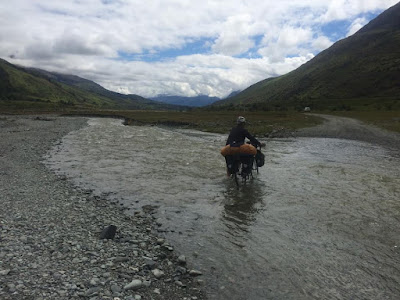
The second ford crossing.
The Belgian couple were very friendly, and had cycled from Belgium to Turkey, then took a plane to Australia and cycled from Sydney to Melbourne.  They actually cycled the Barry Way, which I had done previously and was some of my favourite riding in Australia, so they quite enjoyed their short tour of Australia before coming to New Zealand.


I set off early the next day expecting to be caught-up by the English girl, who was traveling much lighter than me, and sure enough, after an hour or so we met at the first stream crossing.  After that we decided to cycle together for the rest of the way.  I just about managed to keep up, although I did bomb past her going downhill as the weight of my bike creates quite a lot of momentum.

Ronnie looking on to the Von Valley.
It was ironic that the only day of the whole tour that I rode with someone was the last.  It was great as Ronnie was good company and it was nice to get some pictures of me on the bike.  Once we got into Walter Peak, she crossed to Queenstown on the ferry and I went to a free campsite close to shore, which was absolutely stunning.  The two best campsites on tour were on the last two days.


Although the tour had officially ended, I now have plenty of time left in New Zealand.  After a few days in Queenstown, I will be joined by my wife, Eunji, for two weeks in the car and I will be revisiting some places and making sure I get to other parts I didn't reach this time around, especially the West coast of the South Island.


With a few days wait in Queenstown, I used the time to do some weight training, some sprints, hiking, and some trail running to wake up the legs that had adapted mainly to cycling for the past few months.  I was also keen to explore some of the back roads and trails of Queenstown and Arrowtown while I had some time.


Amazingly, over the last 8 months of touring on the bike, I have managed to do things almost exactly on budget.  My aim financially was to be able to fund the everyday expenses (food, accommodation, bike repairs and new parts, etc) of the tour by earning approximately $200 a week teaching English online.  At the end of the tours of Australia and New Zealand, I find myself about $50 to the good in this regard.  I accepted that expensive trips like scuba diving, whale watching, and other adventures would have to be funded out of my savings.  In Australia, I spent far more on these things, but in New Zealand it was only really 2 scuba dives at opposite ends of the country.  I will probably also do something with Eunji when she gets here too.


So that's me probably done with New Zealand on a touring bike.  I feel like I have explored this beautiful country extremely well now, although I can see myself at some time in the future coming back to do some shorter trips cycling the trails.  This trip was even better than the first and has definitely reinforced my affinity for this beautiful country.

The most amazing free campsite of the trip was on the last day.